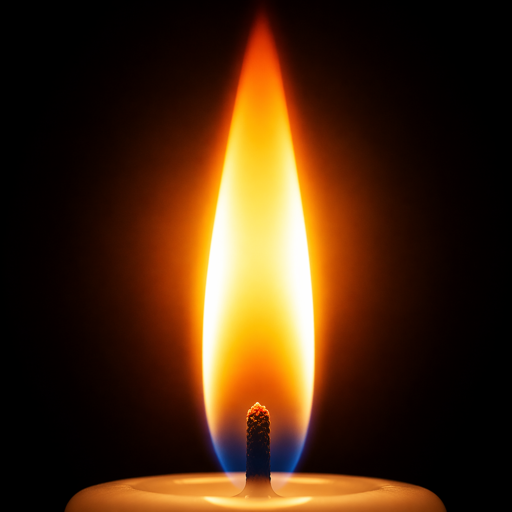
 Tomoshibi
Quick answer: A candle suits ritual because it is alive in a way objects are not — it moves, consumes, and can die — while also being fragile enough that lighting it is an offering of attention, time-bound enough to give a ritual duration, and directional, since flame points upward. That grammar recurs across traditions: memorial candles give shapeless grief a place and a form, the Jewish yahrzeit light burns for roughly 24 hours on the anniversary of a death, Catholic and Orthodox votive candles continue a prayer after you walk away, and the diya of Hindu, Jain, and Sikh practice stands for light over darkness, multiplied by the millions at Diwali. Birthday candles invert the script by being extinguished rather than tended, and across all of them electric and virtual versions have become common where open flames are not allowed — the meaning lives in the remembering, not the combustion.
Ask why humans light candles and the practical answer — light in the dark — explains almost nothing about how we actually use them. We light candles at gravesides and birthday cakes, in cathedrals and on windowsills, for gods and for grandmothers. Electricity solved illumination a century ago, yet the ritual flame never went out. Across wildly different traditions, a small controlled fire keeps being chosen to carry our biggest feelings: grief, hope, gratitude, celebration, and memory.
Why does a flame carry meaning so well?
A candle has a rare combination of properties for ritual. It is alive in a way objects are not — it moves, consumes, and can die — which makes it a natural stand-in for a life or a prayer. It is fragile, demanding a moment of care to light and shelter, so the act itself becomes an offering of attention. It is time-bound: a candle burns for hours and then ends, giving rituals a natural duration. And it is directional — flame points upward, an almost universal human metaphor for things rising beyond us. Few objects say “this moment is set apart” so economically.
Memorial candles: grief made visible
Lighting a candle for someone who has died may be the most widespread candle ritual of all, crossing religious and secular lines alike. Churches keep banks of votives flickering for the remembered; roadside memorials gather candles within hours of a loss; online, virtual memorial candles have become a fixture of condolence pages. The logic of the ritual is gentle: grief is invisible and shapeless, and a flame gives it a place and a form. Tending a light for someone is an act of continued care when no other act is possible — a way of saying you are still part of my evenings.
What is a yahrzeit candle?
Judaism formalizes memorial light with particular beauty. On the anniversary of a death (the yahrzeit), and on certain holidays of remembrance, it is customary to kindle a candle that burns for a full day in memory of the deceased. The practice is often connected to the verse from Proverbs, “the soul of man is the lamp of the Lord.” A yahrzeit candle traditionally burns for roughly 24 hours — which, in a modern apartment, collides directly with the rule against leaving flames unattended. It is no accident that plug-in and LED yahrzeit lamps have become common and widely accepted for safety; the meaning lives in the remembering, not the combustion.
What is a votive candle?
In Catholic and Orthodox Christian practice, a votive candle is lit as an act of prayer — for a person, a worry, an intention — and left burning as a continuation of that prayer after you walk away. The word comes from the Latin votum, a vow or offering. Something in this practice travels well beyond church walls: the secular version, naming an intention while lighting a candle, has become a common mindfulness and journaling habit. Writing the intention down — a name, a hope, a single word — turns a vague feeling into a commitment you can see.
What is a diya?
In Hindu, Jain, and Sikh traditions, the diya — a small oil lamp, classically clay with a cotton wick in ghee or oil — is lit daily in home shrines and multiplied by the millions at Diwali, the festival of lights. The diya’s symbolism is explicit: light standing for knowledge, goodness, and the victory of light over darkness; rows of lamps welcoming prosperity and marking the triumph celebrated in the festival’s stories. Like the yahrzeit light, the diya is increasingly supplemented by electric versions in apartments and dorms — the glow endures where open flames cannot.
Where do birthday candles fit in?
Not every candle ritual is solemn. The birthday cake’s candles — likely descending from German Kinderfest traditions of the 18th century — invert the usual script: instead of tending the flame, you extinguish it, with a wish and a single breath. It is still the same deep grammar, though: a flame marks a moment as special, one candle per year makes time visible, and blowing them out gives the moment a crisp, celebratory ending.
How do you keep candle rituals alive in modern rooms?
All of these traditions assume something our living spaces increasingly do not allow: an open flame you can leave burning. Dorms, hotels, hospitals, care homes, and many rentals prohibit candles outright; safety guidance rightly forbids unattended and overnight burning — yet remembrance, by its nature, wants duration. This is the honest case for the virtual ritual candle: not as a replacement for tradition, but as the form tradition takes when the room says no. A flame on a screen can hold a name, burn through the night without risk, and be lit at a hospital bedside or on a flight home for a funeral. What consecrates a ritual candle was never the wax; it is the intention, the name, and the returning.
How Tomoshibi helps
Tomoshibi carries these rituals deliberately. Premium includes a Memorial mode (a quiet flame in memory of someone loved), a Prayer mode with a written label for your intention, a Yahrzeit mode with a traditional label, a warm Diya lamp for reflection and celebration, and a Birthday mode with multiple candles you blow out with a tap. Custom timers run up to 12 hours, the flame burns on a battery-friendly true black screen, and everything works offline — in a dorm, a hospital, or mid-flight. No ads ever interrupt a moment of remembrance.